
Hyundai Material Handling Completes 4-18 Tonne High-Voltage Electric Forklift Range
- Plant News
-
Sep 30
-
4 min read
- Share post
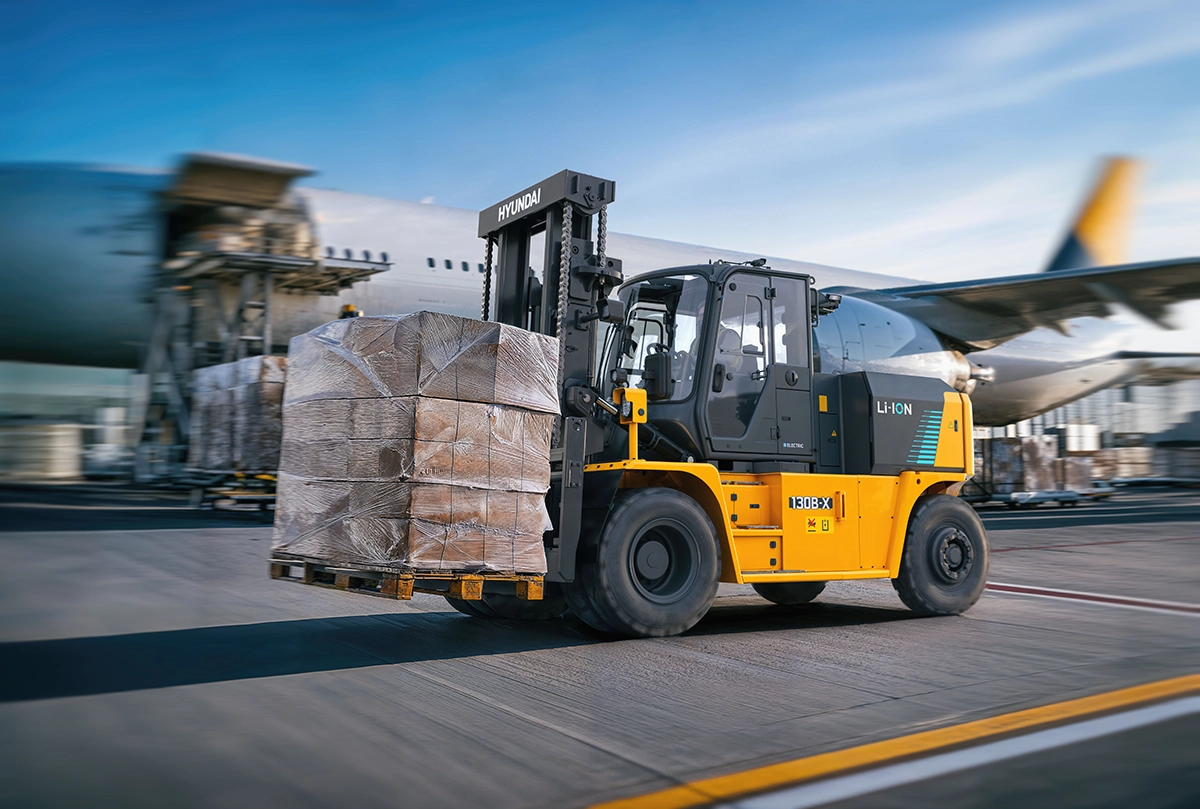
HYUNDAI MATERIAL HANDLING COMPLETES 4-18 TONNE HIGH-VOLTAGE ELECTRIC FORKLIFT RANGE AS ELECTRIFICATION EXPANDS INTO HEAVIER-DUTY APPLICATIONS
Tessenderlo (Belgium), September 2026: The completion of Hyundai Material Handling’s B-X electric forklift range marks another step in the ongoing electrification of heavy-duty material handling equipment. With the introduction of the 10-13 tonne and 16-18 tonne models, Hyundai now offers a high-voltage electric counterbalance forklift range covering capacities from 4-18 tonnes, extending electric forklift availability into applications traditionally served by diesel-powered trucks.
The B-X programme was introduced in stages, beginning with the 4-9 tonne models launched in 2025. The latest additions, comprising the 100B-X, 120B-X and 130B-X LC600 models together with the 160B-X and 180B-X LC600, complete the range and bring high-voltage electric forklifts into applications requiring higher lifting capacities and intensive outdoor operation.
Electrification beyond the warehouse
While electric forklifts are now well established in lower-capacity warehouse and industrial applications, electrification becomes more complex as lifting capacities, operating hours and environmental demands increase. Higher-capacity trucks require significantly more power and battery capacity, while many of these applications involve continuous outdoor operation in changing weather conditions.
High-voltage architecture for heavy-duty applications
High-voltage battery architecture is one of the key technologies enabling this transition. Hyundai’s B-X range uses high-voltage systems ranging from approximately 309-348V in the 4-9 tonnes models to 618V in the 10-18 tonnes machines. The higher operating voltage enables the forklifts to deliver the power levels required for intensive handling operations, while reducing electrical current, lowering heat generation and improving overall energy efficiency.
The heavier B-X models have been developed specifically for sectors where diesel forklifts remain widely used, including ports, shipbuilding, timber processing, metal production, construction materials, manufacturing and logistics operations. In such applications, equipment is expected to operate outdoors throughout the year, often in rain, cold temperatures and dusty environments.
To meet these demanding requirements, Hyundai combines established chassis and mast architectures with dedicated electric drivetrains, battery systems and control technology. Key components are protected to IP67, while selected electronic systems achieve IP69K protection. The battery system combines liquid cooling with dedicated thermal management and integrated heating, to maintain battery operating temperatures across a wide range of conditions. The trucks have also undergone environmental testing, including water spray, flooding and cold-climate endurance assessments.
A further objective has been to deliver performance comparable with diesel-powered equipment. Hyundai reports that the trucks use water-cooled permanent magnet motors and advanced control systems designed to provide travel speeds, lift speeds and gradeability comparable with diesel-powered equivalents. The use of high-voltage architecture also supports fast-charging capability and extended operating times, allowing the trucks to be integrated into intensive multi-shift operations where appropriate charging infrastructure is available.
Commenting on the completion of the range, Raymond Galavazi, Senior Product Manager at Hyundai Material Handling Europe, said: “Completing the B-X range means that electrification is no longer limited to the lower-capacity forklift segments. Customers across a wide range of industries can now consider high-voltage electric trucks from 4-18 tonnes, also for demanding outdoor applications where high capacity and intensive operation are required.”
The completion of the B-X range reflects a wider trend within the European material handling sector, as electric powertrains gradually move beyond warehouses and distribution centres into heavier-duty industrial applications previously considered difficult to electrify.
View PlantClassifieds YouTube Channel.
Please send us your newsworthy plant hire press releases. To find out more, please see the benefits of posting your press release on PlantClassifieds.
About Hyundai Material Handling
HD Hyundai was founded in South Korea in 1972 by Chung Ju-yung, originally as a shipbuilding company. Today, the group holds leading global market positions in shipbuilding, the upstream oil and gas industry, and the refining industry. Since the 1980s, the company has expanded its business into construction machinery and forklift trucks. The first Hyundai forklift truck was launched in 1975, and Hyundai has been active in the European market since 1995.
Hyundai Material Handling, founded in 2020, manufactures electric, diesel and LPG-powered forklift trucks with a lifting capacity of 1.5 to 30 tonnes, as well as a comprehensive range of warehouse equipment. The company serves a wide range of industries, including logistics, distribution, shipbuilding, steel production, the automotive industry and the chemical industry. Hyundai Material Handling is committed to delivering the highest quality through continuous research and development, innovative technologies and state-of-the-art factory automation, combined with competitive pricing and in-house manufacturing capabilities.
With production facilities in Gunsan and Ulsan in Korea, as well as a further plant in China, the company has a total annual production capacity of around 25,000 units. In Europe, Hyundai forklifts are distributed through a network of more than 60 dealers in 27 countries. Hyundai Material Handling has subsidiaries worldwide in the USA, Europe, Korea, India and Brazil, supported by a dealer network of more than 310 partners in 121 countries.

Comments
Add a comment
Leave a Reply · Cancel reply
You must be logged in to post a comment.


